Tuesday, May 29, 2007

One Hour Per Day

Dig into Blender. Get Cinelerra to compile on the MacBook. Read Domain-Driven Design. Write my build-management app. Find more pictures to delete. Take more pictures.

…or…

Spend time with my wife.

I get (or should only use) one hour of time for myself every evening. Sometimes more, sometimes less, but after chores that’s usually what is left. And yet I’ve got all these great things that I would like to get done:

I want to dig into Blender because a) it’s a great tool, and b) I really want to generate a first-rate virtual walkthrough of the new building. Even if I just settle for rendering photorealistic interiors, there’s a lot of time to be spent learning the tool, modeling, texturing, lighting, etc.

I want Cinelerra to compile because it’s probably the best video editor I’ll own for under $300 (if you can ignore the file format problem). That it costs no money at all is even better. However, it certainly isn’t free. I’ve already spent a HUGE amount of time trying to get it to work, so far without success. By the time I finally get it working, I’ll be able to spend $100 for Adobe Premiere Elements for Mac and be done with it, anyway.

I want to read <b>Domain-Driven Design</b> to a) help with my build-management app, but mostly b) to help with my career. It looks like the kind of design book I’ve been needing to read. And after that, there’s the Fowler book. Then LINQ. And I can always practice by developing a tool that will help at work – my build-management app.

And photography is probably my life hobby. Even when I “stored” the camera in the bedroom, it came back out after a week. I just can’t leave it alone.

But, of course, I am married to a beautiful girl. I really enjoy spending time with her: talking with her, laughing about the day, planning for the next, and all the other things that husbands and wives do.

One hour per day.

It is kinda funny, but also infinitely wise that God provided two great ways for us to reveal,.judge, and improve our character – money and time.

We get as much money as the world thinks we’re worth, and each person is (rightly or wrongly) valued differently. How we spend our money, however, is a function of character, not income. Both upper and lower economic classes have people with both good and bad character. And their checkbooks usually tell the tale.

But God gave each of us the same number of hours in a day. Twenty-four of them. None is richer, none is poorer; we all have the same amount of time in a day. Sure, you could say that some have more days than others. But no one knows how many days they have left. So we’re stuck with the time we have today.

When the better priority sleeps next to me every night, why do I feel so driven to get it wrong?

Wednesday, May 23, 2007

Florida Was AWESOME!

Sorry about the utter lack of activity over the last couple of weeks. We were in Florida last week - St. George Island, to be specific. Heavenly. Did absolutely nothing but swim and take pictures. Some friends from Memphis (Collin and Vicki) came with us, and Collin brought all his photography equipment. Being able to play with a studio flash and softbox for a whole week was truly...illuminating. Got some great pictures with it, and had fun at the same time. And it sounds like I got him hooked on Lightroom in the process.

Anyway, I'll be posting pictures later. I'm still excited about Cinelerra (trying to get it to compile under OS X right now), and I'm also rediscovering Blender. But I'm still catching up both at work and at home, so I must leave again for a bit.

Later!

Wednesday, May 09, 2007

Cinelerra - The Wow started last night

I’ve finally gotten Cinelerra installed at home, and I am in love.

A couple of nights ago I finally got Cinelerra to compile on my Ubuntu Fiesty installation on my desktop. (The instructions I was following didn’t mention the gettext package as a requirement. I may email the author.) And after some file format confusion, I started playing around and going through the HV manual.

As I began to learn about and understand the interface, I realized just how powerful of an editor Cinelerra is.

I’m really looking forward to what they call “two-window editing.” I’ve never done editing like that before (except in the backwards implementation that is iMovie HD). It’ll be an adjustment from the straight-up timeline NLE I’ve been using (Vegas Video). But I was impressed with the two-window editing idea, really impressed with the keyboard shortcuts (especially the numpad-based shuttle controls), and I was also pleasantly surprised at how easy color correction was. I have some reservations about adding transitions (since I’m so accustomed to automatic crossfades when I drag one “edit” to overlap another). But I expect my editing workflow (and my output) to improve dramatically.

While I haven’t done anything “serious” with it yet, I’ve got a project for church that I’ll probably start in a couple of weeks. It’s good enough that I might just install Ubuntu on my MacBook just to play with it on a more powerful machine. I may even convert my desktop’s 300GB SATA drive to EXT3 (which is read/write under XP with the right driver), just so I’ll have room to do proper editing.

Friday, May 04, 2007

To Read: Two DI frameworks

I really need to make time to read about these frameworks:

Spring.net
The Castle project

Three-Girl Circus

It looks like my sweet wife has finally written her first blog post! While I'm no big-time blogger, it's cool to see her get started. I'm really looking forward to reading her blog, even though I live in the circus!

Anyway, check out my link to the Three-Girl Circus at right to see what she has to say.

Domain-Driven Design

I finally bought Domain-Driven Design, and I got it yesterday. I'm still just in the first chapter, but it really is a fascinating book. Evans isn't giving a lecture on design; he's telling stories from his experience, and letting the stories educate the reader. And he's such a good storyteller that not only am I learning quickly, but I actually hate to put it down! I expected to learn and be interested, but I never thought a book on software could be this engaging.

As you may have seen from the flurry of posts I've been submitting recently, the topic of better software design has been stirring in my head for a few months now. I'll elaborate on that in another post. It is sufficient for now to say that my purchase of Domain-Driven Design was exceedingly well-timed. Despite my recent lack of faithfulness to God, He seems to be heaping grace upon me anyway - educating me and helping me in my career despite myself.

God never ceases to amaze me.

Thursday, May 03, 2007

Technique Digestion

Try the following policies on for size:
  • GAC - Only interfaces and the DI container engine ever get put in the GAC
  • Interfaces - All application- or layer-boundary interfaces should go into the GAC. Application interfaces may share the application's namespace, but the application's interfaces must reside in a separate assembly. The interface assembly(ies) must go in the GAC; the implementation assembly(ies) must NOT go in the GAC.
  • DI Container - Goes into the GAC, and has machine-level config info telling it which class versions implement which interface versions. Should support interface version redirection, preferably by reading policy files stored in the GAC.
  • Domain interfaces and implementations should follow the same rules as an application's interfaces and implementations.
  • Domain classes and interfaces should NOT share either assemblies or namespaces with application-specific logic. This will allow them to evolve independently, and makes domain object reuse across applications much easier.
  • Both domain objects and application- and infrastructure-specific services must always be instantiated via the DI container, or returned from factories that reside in the domain class's assembly.

Technique Indigestion

Gnawing questions:

Why do we tie domain objects and service interfaces to specific applications, sometimes all in the same assemblies and namespaces?

How can application interoperability survive the evolution of the business' domain knowledge/model? When applications finally get rewritten, they're typically also renamed, and frequently application borders are redrawn. This happens largely due to evolution of business domain knowledge. How can application interoperability survive? One answer: The new app can implement the old app's interfaces w/ proxies - in their own namespaces and assemblies - that consume the new app's interfaces. While the temptation in a DI-enabled environment might be to just have the new app directly implement the old interfaces, that presents a growing burden on successive iterations of software. Better to have independent proxies that can cascade, and that can be dropped as needed.

Think about what best practices would incorporate all of the following in enterprise-level apps:
  • Dependency Injection
  • Interfaces
  • Domain objects
  • Namespace boundaries
  • Application boundaries
  • Assembly boundaries and version numbers
  • What should be in the GAC, and what should not
Think about all this while reading Domain-Driven Design in Florida.

MacBook Hard Drive Upgrade Successful (part 2)

It's kinda funny, the psychological effect that RsyncX has had on me. Maybe funny, maybe not.

I've been planning to write my own sync program (yes, called Sync) in mono for quite some time. And my intent has always been to maintain a mirror of my Lightroom database and pics.

Now, RsyncX can maintain a bootable mirror of my MacBook's whole hard drive.

I don't know what to design anymore.

I still find myself out of habit re-entering the design process for Sync whenever I get a minute or two of spare CPU time. And right about the time I have to return my attention to whatever I'm supposed to be doing, I remember RsyncX, and realize I've just wasted several minutes of downtime.

Maybe I'll pick back up that project build-management design I was working on during my infatuation with RoR.

Or, maybe, I'll just read a good book.

MacBook Hard Drive Upgrade Successful


I must confess I was a little scared about upgrading the hard drive in my MacBook. Apple's computers are things of beauty, not collections of parts lacking a soul.

But thanks in large part to the ease-of-use and shocking functionality of RsyncX, it was easy to make a bootable backup on an external drive's partition, swap the hard drive, and boot to the external backup for the restore.

Kudos, Apple and RsyncX! Now I've got my entire Lightroom library on the internal drive!

Hello 2007 (yawn)

My dear, sweet wife has been reading blogs by Christian moms for several weeks now. She has recently decided that our family should have a blog, too. And her sudden interest in blogging finally reminded me that I have a blog.

So, to remind myself what blogging feels like, here's my first post in eleven months.

Cheers!

Tuesday, June 06, 2006

Ann Coulter's "Today Show" Interview and religion

I must respond to Ann Coulter's interview on The Today Show this morning.

Ann Coulter does NOT represent the views of all conservatives or Christians. As a politically-conservative Christian, I very much resented how she represented those two groups of which I am a member.

Ms. Coulter's book (which I have not read, though I intend to) appears to be wrong even from the title. From what she said in the interview, how she said it, and how she named her book, she appears to be a political conservative (though NOT a Christian) trying to incite the large Christian base of the Republican party into a frenzy over whatever claims she makes in her book. What's sad is that she either doesn't know or doesn't care how much her own desperation is hurting her cause and that of those she claims to represent.

There IS a religion for Christians to be aware of, however, though Ms. Coulter misses it completely. I am sure that there are many well-meaning, sincere, and faithful Christians who vote on the left side of the aisle. I harbor them no grudge. I am also CERTAIN that there are many political conservatives who are as godless as can be.

And this brings me to the religion that Christians need to be aware of. Philosophers would (these days) call it "scientific naturalism". Preachers would call it "godlessness" (as I will in this post).

Godlessness is every bit as much a religion as Christianity. But to back that statement up, I'd better define the term "religion." A religion starts from a fundamental assumption. Someone who adheres to a particular religion makes at some point a decision to believe or accept the religion's fundamental assumption. This decision is made apart from any evidence pro or con. Those who believe in a religion will often expend considerable time, money, and effort to convert others to their religion. Most of these resources are spent trying to "prove" the fundamental assumption of the religion. But for some people (regardless of religion), the effort to "convert" is more of a jihad than anything else. These extremists consider as enemies those who do not accept their religion.

Now let's compare Christianity and Godlessness. The fundamental assumption for Christianity is that the Bible is true, and that God created everything we see and set it in order. The fundamental assumption for Godlessness is that God does not really exist, and that everything we see can be explained by the interaction of time, laws of nature, and random chance.

The Intelligent Design "movement" seeks to prove the fundamental assumption of Christianity. However their approach has two fatal flaws. First, they're trying to prove a decidedly metaphysical statement through physical evidence. Second, they're trying to prove something (the existence of God) while vigorously disclaiming any knowledge of the implications (the rest of Christianity).

The scientific community at large has the same fundamental flaws, however. They're trying to prove through physical evidence that God does NOT exist, which suffers the additional logical problem of proving a negative. They're also trying to support through evidence, research, and experiments a decidedly religious statement ("God does not exist") while emphatically denying that they support any religion at all.

I do not appreciate Ms. Coulter's representation of Christian conservatives. And I believe that she is wrong on several of her main points. But I appreciate her raising awareness that there IS a religion that's permeating the courts and lecture halls without acknowledging itself as a religion. I just wish she had correctly identified it, and been more tactful in drawing attention to it.

Monday, April 24, 2006

Mixing Flash and Ambient Light


I've been playing a bit lately with using flash in combination with available light for various purposes.


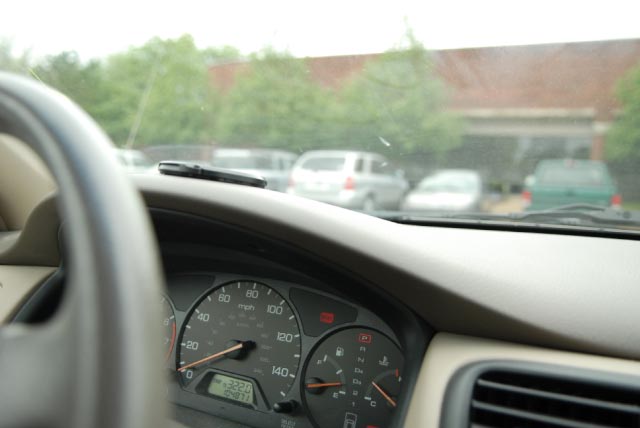
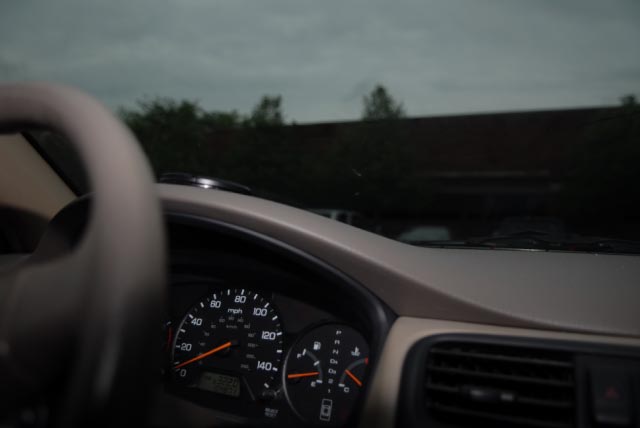
A lot of what I've done has been testing. For example, the following pictures I took in my car.

The first picture shows the scene as metered by the camera. The speedometer is washed-out, almost to the point of losing detail due to lack of contrast. And the sky is completely blown out.

The second picture shows the scene severely underexposed for ambient light, but I had my flash set to use high-speed sync. The shutter speed was 1/8000 of a second, forcing the flash to fire multiple times to illuminate the entire frame. Here you can see the speedometer is properly exposed, but the sky is quite dark.


In this next pair of images I illustrate the effectiveness of using bounced flash for fill. My daughter was looking out our front door while holding on to the gate (eating it, actually).

In this first picture you can see how the scene would be if it were lit only by available light. With the image properly exposed for the trees in the background, only a small sliver of Emily's face retains detail.

In the second picture, you can clearly see the effect of the bounced flash. While it's obvious that the picture is better-lit, it would be difficult to tell why without knowing. And someone who hadn't seen the first picture might not realize that any light had been added to the scene. (The same technique was used for the pictures at the top and bottom of this post.)


These last two images were taken at our church's annual Easter egg hunt. Both pictures would have had extremes of contrast, since the sunlight was very harsh. However, I had my flash on the camera for use as fill, and it saved most of the pictures I took that day.
The first picture shows how fill flash can be used to subtly reduce contrast in shadow areas. My daughter would have been recognizable, but the picture would have required extensive curves processing to get a similar result without flash.

The second picture would have left you wondering who the picture was taken of. As it turned out, my mother's smile shows up great despite her being strongly back-lit.


Sorry if this one post bored you, but it's exciting to me to see the possibilities opened - and the shots saved - by techniques like this.

Thursday, March 23, 2006

MY D200


New class of camera, new class of photos.

I must say, I'm amazed. If you'll remember, I spent a week at my Dad's house playing with his D200 over Christmas vacation. I was impressed then.

I'm AMAZED now.

The D200 is SUCH a wonderful camera! It begs you to carry it in your hands all the time, despite the weight. Enough features to make you feel like you've got a pro camera, enough options to convince you it was tailor-made to your specifications. Yes, it's got banding, so it might go back to have the A/D converters replaced and calibrated at some point. But I've run into banding in perhaps 5 shots out of around 1000 I've taken in the month or so that I've had it.

And that lens! The 17-55/2.8 DX is worth every cent you pay for it. Like the D200, it makes your hand more comfortable to be holding it. Truly a luxurious lens, it's obviously designed for professional photojournalists who would have to live with it day-in and day-out. It can out-resolve my D200's 10MP sensor, even wide-open at f/2.8. And the contrast is like nothing I've seen (and I've played with some of Canon's L lenses from time-to-time). Truly an optical marvel.

The combination of D200 + 17-55/2.8 just can't seem to go wrong. Focusing is ALWAYS fast and ALWAYS accurate. Any focusing errors can always be attributed to user mistakes. And with the SB600 - on OR OFF the camera - the pictures almost make you cry. They're just that good.

Anyway, enough talk. Here's the pictures!


ISO 1600, WB set to Incandescent+3, lit by the chandelier over our kitchen table


Lit by SB600 on-camera, bounced off the ceiling. Yes, the ball hit the lens hood just a split second later. My daughter's face is in PERFECT focus.


Her Papa was throwing her onto the couch cushions when I decided to try for the mid-air shot. It took me four tries, and he had already been throwing her a while. But the camera did its job, and I love the results. SB600 bounced off the ceiling, after pre-focusing on my father-in-law.


I was playing with the SB600 on its stand bouncing through Carrie's sewing machine to get a good shot of her. While I still haven't gotten exactly the shot I want (will probably require multiple lights), this shot turned out great.


I really like this one. AS you can tell, it was almost bedtime, Carrie was holding Emily (our youngest). Then Mara got jealous and crawled up into her lap, too. SB600 on-camera bounced off the ceiling.

I'M GOING TO BE A DAD (again) !!!

OK. It's been a while since I've posted. Fine. I make the same money whether I blog once a day or once a quarter.

Carrie and I have found out we're having another baby! Currently due the first week of October. We won't know what "kind" it is until we get back from our Florida vacation, though. That means another blog post mid-May with the news. We might not have a name at that time. However, we'll DEFINITELY do better than some friends we have at church - they'd had two names competing for their child for months, but the hospital staff had to force the decision before releasing the child. !!!

Anyway, I had to post about that. EXCITING!

Later!

Friday, December 02, 2005

Nikon's D200

I've got Canon's Digital Rebel. It's a great little camera at a great price. Beautiful images at low cost, made by the market leader in SLR cameras. I'm married with two kids, and I just got really interested in photography a year ago. So my lens "collection" is really a pair of $100 lenses and my pride-and-joy, the $450 Sigma 30/1.4. (The Sigma is a non-zooming lens that offers a natural field-of-view and is great for low-light situational stuff.)

Mike (a friend at work) shoots with Nikon gear. He's single (never been married), older than I am, and has been collecting Nikon lenses since he majored in photography in college. So his lens collection is really a "collection". He just bought Nikon's newest pro digital - the $4500 D2x - to replace the other DSLRs he's worn out.

Mike and I regularly give each other grief about which brand is better. As a routine part of this verbal sparring, Mike has repeatedly stated that Canon is a marketing-driven company, while decisions at Nikon are made by engineers. I always dismissed this as a colored perspective that wasn't really harmful or offensive.

Until Nikon released the D200.

The Overpriced, Underfeatured Canon 5D

Really, it started with Canon's recent release of the 5D. It's way overpriced, in my opinion. At $3300, it's just a $1300 20D with a sensor the size of a 35mm negative. That makes it the first full-frame DSLR available for under $4000. But at that price, I was really expecting the feature set to closely resemble the sports shooters' workhorse - the $4500 1DMkIIN. Weather sealing, 45-point pro-speed AF, and other pro features should be in a $3300 camera. Nope. Just a bigger screen...and a print button.

That print button irritated me more the more I thought about it. Who among the target audience for this EXPENSIVE camera would want a button just for printing? It's a waste of money, a waste of real-estate, and - worst of all - a waste of a perfectly accessible button during shooting. Reviewers everywhere commented on it. And I realized that maybe Mike was right - maybe some Executive Vice President of Marketing decided that "all Canon digital cameras will have a Print button." Starting with the $3300 5D.

The Underpriced, Overfeatured Nikon D200

Meanwhile, Mike had told me what to expect of the D200 - basically a pro camera in a smaller package, priced around $2500 (as was its predecessor, the D100). Sounded like a nice camera (even if it was four years late), but it was WAY too rich for my blood. Besides - I had Canon lenses. Even my humble $650 of glass counts (for me, anyway) as an investment.

So when the D200 was officially announced, the specs were surprisingly up-to-date for a camera four years in the making. (That's a long time in digital land.)

But I almost jumped out of my chair when I saw the price: $1700, just $200 more than I was already planning to spend on an upgrade in the spring.

My initial elation stemmed from the effect this new camera would SURELY have on the new 20D's feature list. I realized Canon probably hadn't been caught by surprise, but we ordinary folk were just waking up to the pressure Canon had been living under for a few years. A pro camera, with pro AF and weather sealing and cast-iron build and controls for every photographic setting I knew of (plus some I didn't) priced for ordnary people like me. "Who knows what Canon will come up with?" I thought.

But the more I looked at the D200, and the more I looked at my investment in lenses, the more I realized that the D200 was an option for ME. (My increasing skills at selling electronics on eBay was also a factor.) I was already planning on selling the kit lens with my camera. I could sell the Sigma for a little loss and probably make up the difference between Canon and Nikon cameras.

And the features were calling to me: Pro-grade AF that could track my child around the frame. Selectable frame rates, up to 5FPS. A buffer large enough to hold 22 RAW files. Weather-sealing and build that would give me peace of mind should life happen while the camera was out. All are features I would use. All are features Canon has so far reserved for their pro cameras (even the $3300 5D has none of these features). Add to that Nikon's less-confusing control layout with a pro-level degree of control. And by all indications, the D200 yields ISO3200 images with almost as little noise as the excellent Canon 20D.

So my mind is made up...for now. My budget is preventing me from buying anything until after Canon has shown their cards. The 20D's successor is expected to be announced in late February at the PMA conference, with cameras shipping in March. I guess it's a good thing I can't upgrade until then.

But I can drool over the D200 in the meantime :-)

Wednesday, October 05, 2005

Recommended Reading

I STRONGLY recommend the following books:

The Francis A. Schaeffer Trilogy.
Shaeffer was a Presbyterian minister who realized that the "preach and they will come" model wasn't working any more in postmodern Western society. So in the midst of the hippie revolution he moved to Switzerland, where he opened his home to anyone with deep questions still searching for answers. Through his talks with people from all walks of life, and through his studies of Scripture, philosophy, and history, he worked hard to answer those deep questions from a Biblical perspective. This book contains his findings.


His whole-picture, "whole-history" view of society is intriguing, even if it's somewhat hard-to-follow. But the most notable aspect of his writing is the deep, emotional compassion for real people that drives every word on every page. Other works on worldview are dry, analytical, academic. This book is soaked with tears and prayers for those lost in the godlessness of today's culture.


Do Fish Know They're Wet? by Tom Neven.
If Schaeffer introduced modern worldview apologetics to the Church, Neven makes it accessible. Avoiding the rambling of Schaeffer and the "Christianese" of Colson, Neven manages to communicate a difficult subject easily and in a small paperback book. For only $10, you simply must buy this gentle guide to worldview apologetics.

New House

This is the long-overdue post showing pics of our new house. In fact, this post is SO overdue that we don't really think of the house as being "new" anymore. Oh well. Apologies to my many devoted readers.


This is our new house. Lots of trees mean smaller electric bills in the summer, balanced by running the AC more after clearing the yard of sticks and hickory nuts. We have four bedrooms: a master suite downstairs, and a "second master" plus two small bedrooms upstairs. There are 2+1/2 baths, formal dining room plus eating area in kitchen, and a rec room upstairs. Crown molding and smooth white ceilings throughout, with hardwood floors in every room except master suite and stairs. Corner lot in nice, established neighborhood in laid-back Smyrna, TN. Large side and front yards; already-small back yard halved by deck outside kitchen. Two-car garage under first floor.


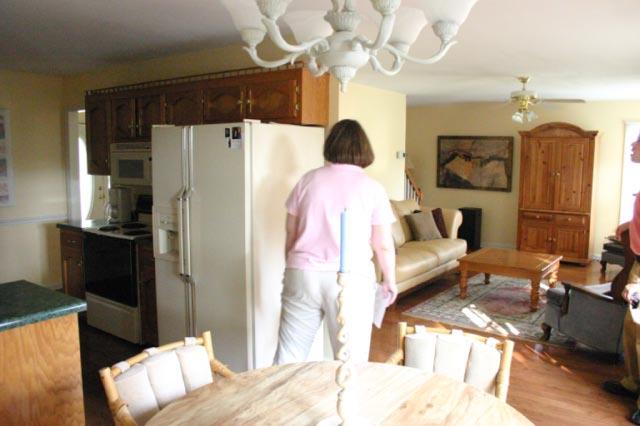
Here's a view of the kitchen. The wall you're looking at is really an "island" of wall separating the entry hall and living room from the kitchen.


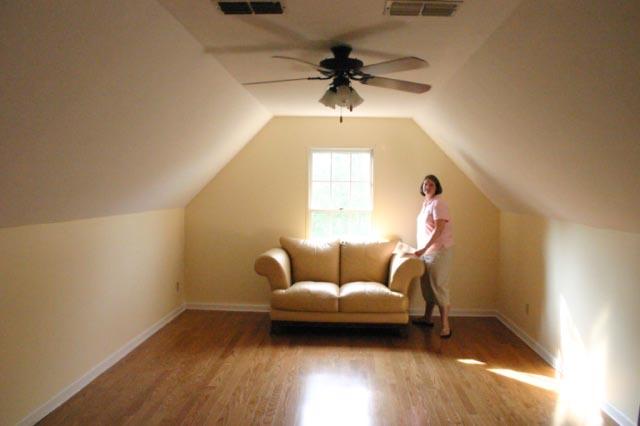
This is our "rec room." It's big enough to be a nice bedroom, but doesn't have a closet. Right now it houses all the boxes we haven't unpacked yet. It's nice to have an extra room big enough to simultaneously serve as attic, play area, guest room, and bedroom for the dog. There's another small bedroom upstairs that we're not using yet.


This is an artsy pic showing the view from the upstairs landing. The stairs go up from the far end of the living room up onto the landing, which is in the middle of the second floor. Doors lead from the landing into all three upstairs bedrooms, and you can walk down the hall to the upstairs bathroom and the rec room. Mara likes to look through the railing at whomever is in the entry hall.


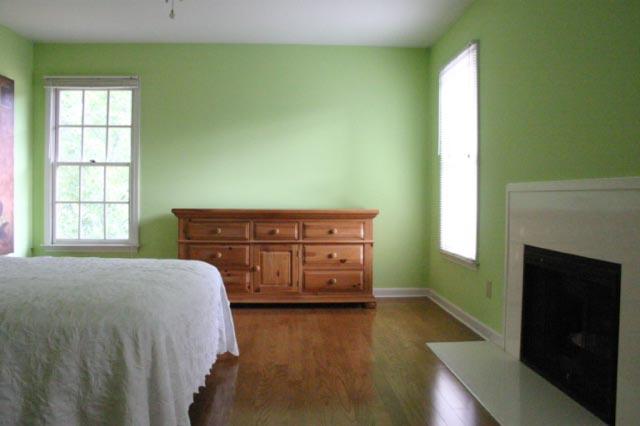
This room has been turned into our nursery. You may think we're crazy, but both of us actually like the green color. The hardwood floors and smooth ceilings come together with the windows and fireplace to give the room an elegant, old-world charm. Of course, having a fireplace in a nursery isn't a good idea, so the crib will sit in front of it for a few years.


This is Mara waiting on us to finish looking through the house. She's sitting in the formal dining room, which became our playroom. It's a great place to keep the toys accessible...but away from the living room. We're planning to install built-in bookshelves and seats on all three walls. The living room is down the entry hall to the left, and the doorway you see goes into the kitchen.


Finally, this is Mara demonstrating the eating area in our kitchen (from which the other kitchen picture was taken). It's also the only picture of the group showing the house as it looks now. (I know, I know - but now that we live here, there's no point of taking pictures of the house by itself.)

Friday, August 26, 2005

It's Release Day, and I'm Bored

Well, for the third time this summer, today is Release Day. Really, it's been Release Week, but today is the big day. Today is the day we can't log into our system because we're rolling the projects we've been toiling over into production.

Release Week (from a developer's standpoint) is a week when projects stand still. Regardless of the official status of things, no developer is assigned to any project during release week so we can help with the preparations. Emails go out listing differences between the various environments. Those responsible reply to claim their code. The QA department goes into overdrive testing projects that are releasing. Development concentrates on bug reports related to the release.

Release Day actually starts at close-of-business on Thursday. That's when our system is shut down. It's also when the DBA and various project leads start rolling database changes to production. This process lasts late into the night. Friday morning they roll the changed database code. Usually around lunch on Friday the QA department can log in and begin testing. And this is the start of the real fun.

QA testing generally lasts from lunch on Friday to close to midnight, and can continue on Saturday. During QA testing developers are basically on standby. We're deliberately kept bored so we can respond immediately if a problem is ever found. We're allowed to bring in game consoles and TVs to help us waste time.

Food is never a problem. Investment Scorecard cares for its employees. We're given multiple menus to choose from for lunch, with different menus for dinner. The food is great - we're not talking about McDonald's, folks. Hot meals. Hot sandwiches and other entrees for lunch. Steaks, salmon, chicken for dinner. All paid for.

The game consoles usually attract a small crowd (whatever can fit in a cubicle). For each console there's generally 3-6 people watching, one person trying to beat the previous score, and occasionally someone working. The breadth of games brought in is impressive, though there are company favorites. Lines form for Halo 2 and Amped for XBox, and sometimes for Gran Turismo 4 for PS2. Card games are also common, with one or two going on at any given time. I have no idea what games they play, though.

I don't happen to have any projects rolling to production this week, and I've not been around long enough to be assigned any standard release-week duties, so I am bored. At least I'm honest about it - my supervisor knows I'm searching for something to do. But it's lunch time, and I know I'll be here another twelve hours watching my brain cells form a puddle beneath my feet.

I was bored, so I thought I'd write about my predicament. I hope you enjoyed it.

Thursday, August 25, 2005

Thoroughly Contaminated

This morning, as I was eating breakfast, I saw my wife's copy of Sew Beautiful by Martha Pullen. As I'm interested in photography, I decided I'd look for the name of the photographer who took the wonderfully done cover photo. (No, I'm not gay or anything. It's my wife's magazine, remember.)

Flipping through the pages, carefully looking for the small print info I sought, I stumbled on the "Dear Friends" page - essentially the letter from the editor written by Mrs. Pullen and included in every edition. However, in this magazine, the letter from the editor takes the form of a short Bible study, complete with printed Bible verses (James 3:7-12 in edition 102). I had not yet had a quiet time this morning, so I read through the article as my study for the day. It was a great lesson on taming the tongue, with personal anecdotes about her father (who apparently did well in this area) and her grandfather, a circuit-riding Methodist minister.

After reading through the devotional, I thought about Mrs. Pullen. How she's obviously very interested in sewing and smocking and in teaching others, and how cool it must be to have her own business (a magazine, no less!) that follows her interests so closely. And I thought how good her business skills must be to have achieved that level of success.

But then I realized just how my last thought smacked of a materialistic (godless) worldview. It really surprised me that I had just held that opinion. Of course Mrs. Pullen is enjoying the blessings of God and the benefits of a life devoted to Him. Even in the secular world business skills are no real indicator of success; we as Christians know why. Mrs. Pullen has apparently been God's servant for many years, and continues to use her media reach to give Him glory. Since her will is aligned with that of God, He continues to bless her in order to further their mutual goals.

So why did I give her credit?

I realized (once again) just how thoroughly contaminated we are with the godless worldview. I continue to be surprised at just how warped my conception of life really is. I believe in God; that He created the world in six literal days' time, that man disobeyed God and fell from created perfection, and that God in His love inflicted our punishment on His Son so He could restore us fully one day. But those central pillars of belief seem to have made little headway into my day-to-day thinking.

I honestly wonder what it would be like if I managed to demonstrate the knowledge of God in every little area of my life. Would my wife think I was crazy? Or would she be amazed that dishes, laundry, and trash were no longer an issue? What would my boss at work think if I had every project on-time and bug-free? (I have known for years that it is God, not me, who writes the software. And He writes it through me most quickly when I'm close enough to Him that He can use my hands.)

This morning I realized (again) that I have much to do, much to learn, and much to unlearn.